
How Do Know Is Step Up Transformer Or Step Down Transformer?
Transformers are indispensable electrical devices in modern power systems, designed to convert alternating current (AC) voltage from one magnitude to another while preserving the original frequency. This functionality is critical for efficient power generation, long-distance transmission, and safe end-user applications—from industrial facilities to residential homes. Among the most common transformer types, step-up and step-down transformers serve opposite but complementary roles: step-up transformers boost low voltages for long-haul transmission, while step-down transformers reduce high voltages to usable levels for equipment and appliances. Below is a comprehensive guide to distinguishing these two transformers, along with an in-depth explanation of their operating principles.
Check the Transformer Nameplate for Definitive Specifications
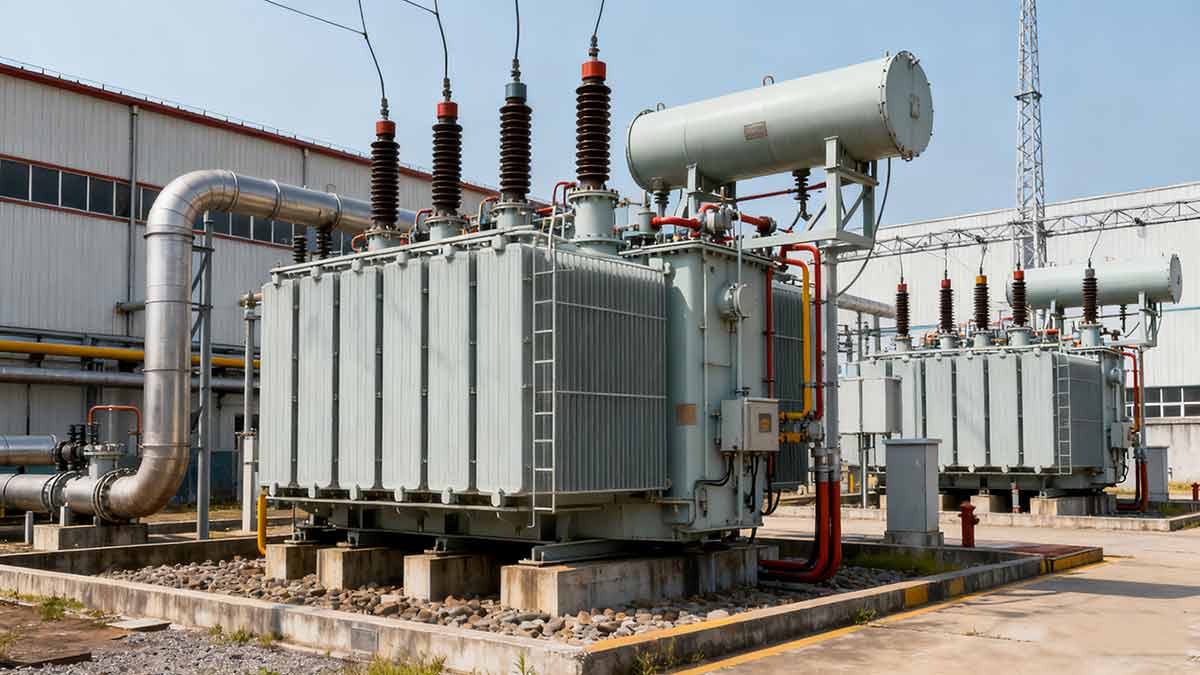
Examine the Tap Changer Configuration
- Step-up transformers: Typically equipped with off-load tap changers (OLTC). These transformers are primarily used in power plants to boost generator output (e.g., 10kV to 220kV) for long-distance transmission. Since transmission voltage requirements are relatively stable, voltage adjustments are rare and can be performed when the transformer is de-energized (off-load). OLTCs are simpler in design, cost-effective, and ideal for applications where frequent voltage changes are unnecessary.
- Step-down transformers: Commonly fitted with on-load tap changers (ULTC). These transformers are deployed in substations or industrial sites to reduce high transmission voltages to usable levels (e.g., 220kV to 11kV or 415V). End-user loads (such as factories, commercial buildings, or residential areas) fluctuate constantly, requiring real-time voltage adjustments to maintain stability. ULTCs allow voltage changes while the transformer is energized (on-load), ensuring consistent power supply without interruptions.
Analyze the Output Voltage and Load-Side Requirements
- Step-up transformer output voltage: The secondary output voltage is intentionally higher than the primary input voltage. For example, a generator produces 10kV, and a step-up transformer boosts it to 220kV for transmission. This higher voltage minimizes energy loss (P = I²R) during long-distance travel, as lower current flows through the transmission lines.
- Step-down transformer output voltage: The secondary output voltage is lower than the primary input voltage. For instance, a 33kV transmission line voltage is reduced to 415V for industrial machinery or 230V for residential use. A key design consideration here is the voltage regulation margin: step-down transformers are often engineered to output a voltage 10% higher than the nominal load-side voltage (e.g., bus voltage or appliance rated voltage). This margin compensates for voltage drops caused by line resistance, load fluctuations, or transformer internal losses, ensuring the load receives stable voltage within acceptable limits.
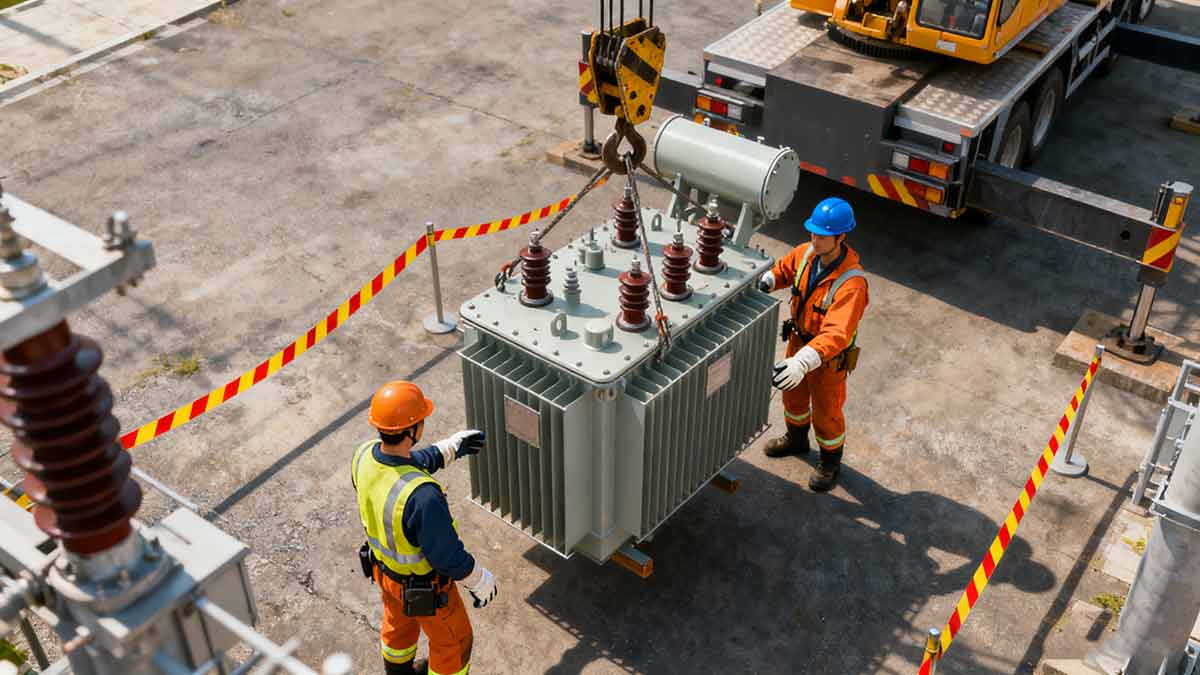
Core Operating Principles of Transformers
- When an AC supply is connected to the primary winding, it creates an alternating current that generates a fluctuating magnetic flux in the magnetic core.
- This alternating magnetic flux cuts through the secondary winding, inducing an electromotive force (EMF) in the secondary coil—per Faraday’s Law of Electromagnetic Induction (E = 4.44fNΦₘ, where E = induced EMF, f = AC frequency, N = number of winding turns, and Φₘ = maximum magnetic flux in the core).
- The magnitude of the induced EMF is directly proportional to the number of turns in the winding. Thus, the ratio of primary voltage (V₁) to secondary voltage (V₂) equals the ratio of primary turns (N₁) to secondary turns (N₂), expressed as V₁/V₂ = N₁/N₂. This turns ratio is the fundamental basis for voltage conversion.
Key Similarities and Differences Between Step-Up and Step-Down Transformers
Shared Principles
- Both rely on electromagnetic induction for voltage conversion.
- Both maintain the same input and output frequency (no frequency change).
- Both consist of primary/secondary windings and a magnetic core.
- Both are designed to minimize energy losses (e.g., copper losses in windings, iron losses in the core).
Primary Differences
| Aspect | Step-Up Transformer | Step-Down Transformer |
|---|---|---|
| Turns Ratio | N₁ (primary) < N₂ (secondary) | N₁ (primary) > N₂ (secondary) |
| Voltage Relationship | V₂ (output) > V₁ (input) | V₂ (output) < V₁ (input) |
| Tap Changer Type | Mostly off-load tap changers (OLTC) | Mostly on-load tap changers (ULTC) |
| Core Application | Power plant output boosting, long-distance transmission | Substation voltage reduction, industrial/residential power supply |
| Insulation Requirements | Higher insulation strength for high-voltage secondary | Lower insulation requirements (relative to step-up) for low-voltage secondary |