
Three Phase Pole Mounted Transformer Line And Phase Voltages
A transformer is a fundamental electrical device designed to regulate voltage, maintain circuit stability, and ensure consistent current flow across power systems. Among the diverse transformer types, three-phase pole-mounted transformers stand out as essential components in overhead power distribution networks—deployed extensively for outdoor applications like rural electrification, commercial building power supply, and industrial park power supply. These units combine robust design with efficient voltage conversion, making them indispensable for balancing electrical loads and delivering reliable power to end-users.
Contents
hide
Core Definitions: Line Voltage vs. Phase Voltage
In symmetrical three-phase systems, two key voltage parameters govern operational performance: line voltage and phase voltage. While these terms are interconnected, they serve distinct roles in circuit functionality.
Line voltage refers to the electrical potential difference between two phase conductors (live wires) in a three-phase setup. This is the voltage measured across the primary or secondary leads of three-phase equipment, such as pole-mounted transformers.
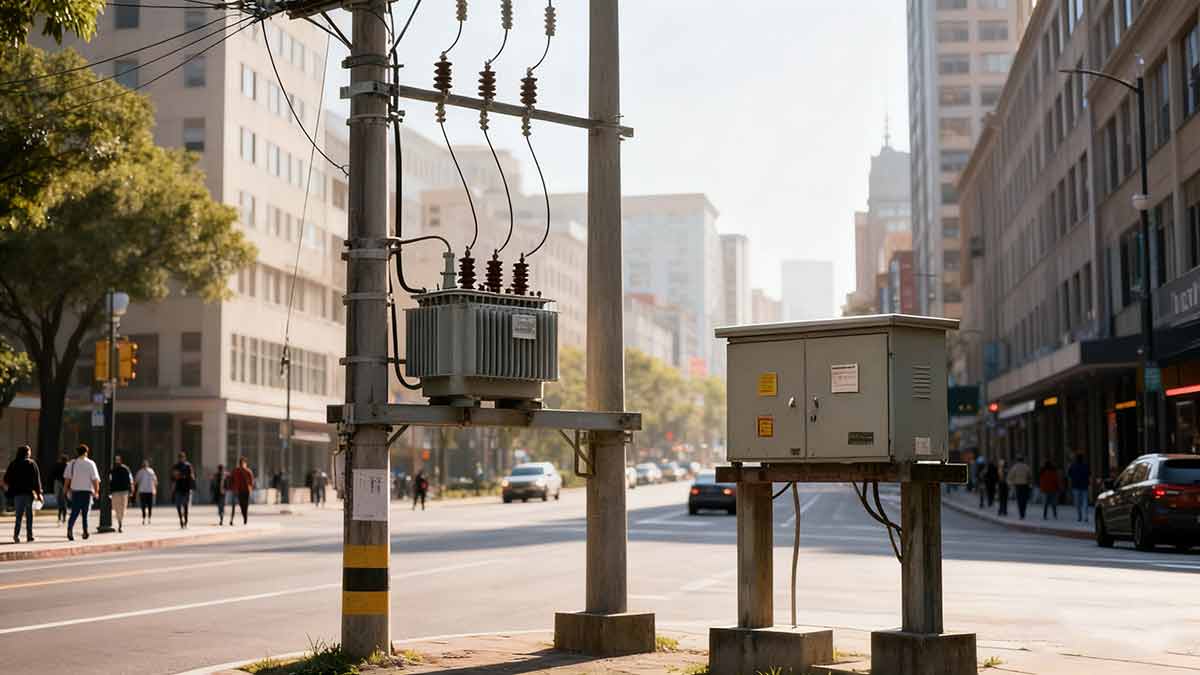
Phase voltage, by contrast, is the potential difference between a single phase conductor and the neutral wire (in three-phase four-wire systems) or between a phase conductor and the system’s reference ground. It represents the voltage applied to individual winding coils within the transformer.
A critical relationship defines these voltages in balanced systems: line voltage equals the phase voltage multiplied by √3 (approximately 1.732). For example, a 230V phase voltage (common in residential applications) corresponds to a 400V line voltage—aligning with international electrical standards for three-phase power distribution.
Voltage-Current Dynamics in Star (Y) and Delta (Δ) Connections
Three-phase pole-mounted transformers utilize two primary winding connection configurations: star (Y) and delta (Δ). Each configuration dictates unique voltage and current relationships, tailored to specific application requirements.
Star (Y) Connection
In star-connected transformers, the neutral wire is derived from the common junction of the three winding coils. Key characteristics include:
- Line current equals phase current (I_line = I_phase), as current flows directly through each coil to the line conductor.
- Line voltage equals √3 × phase voltage (U_line = √3 × U_phase), due to the phase shift between individual windings.
- Ideal for three-phase four-wire systems, where neutral access is required for single-phase loads (e.g., household appliances).
Delta (Δ) Connection
Delta connections involve connecting each winding coil end-to-end in a closed loop, with no neutral wire. Key characteristics include:
- Line voltage equals phase voltage (U_line = U_phase), as each line conductor connects directly to a winding junction.
- Line current equals √3 × phase current (I_line = √3 × I_phase), resulting from the combination of current flows from adjacent coils.
- Commonly used in industrial settings where high current capacity is needed (e.g., heavy machinery, manufacturing equipment) and neutral access is unnecessary.
Practical Measurement and Nameplate Labeling
In field applications, measuring line voltage and line current is far more straightforward than accessing phase parameters—especially for enclosed equipment like pole-mounted transformers. Phase voltage and current require direct access to internal windings, which is impractical for routine testing or maintenance.
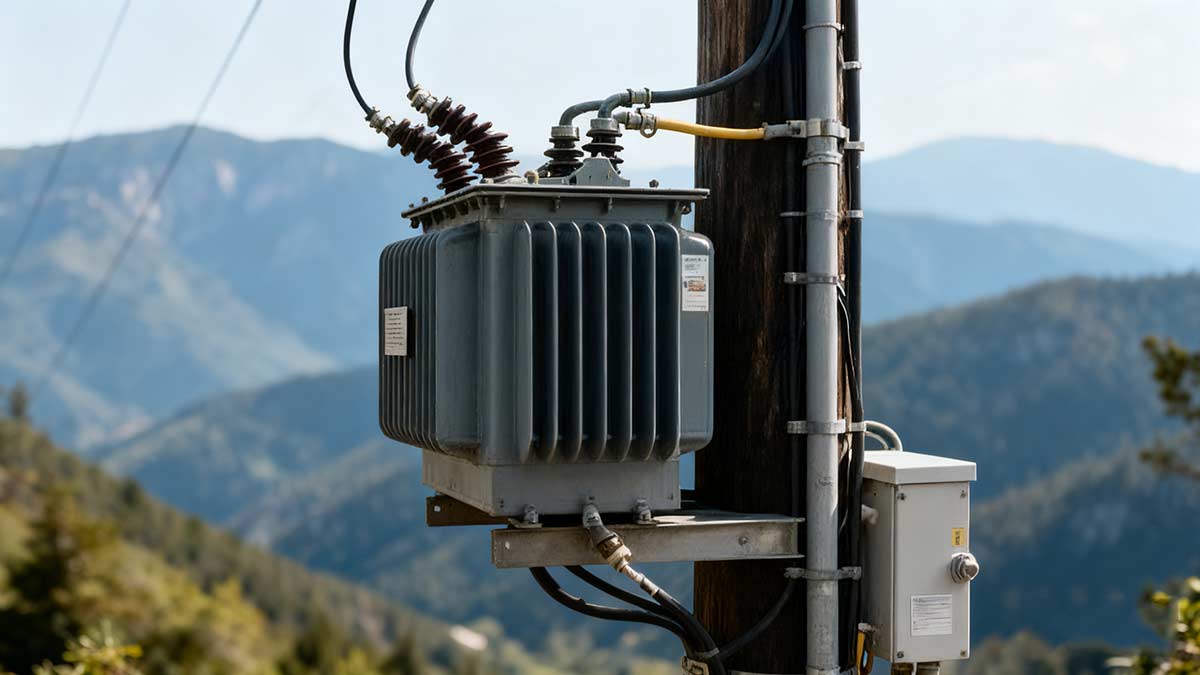
For this reason, manufacturers adhere to industry standards by marking line voltage and line current ratings on transformer nameplates. These values provide engineers, installers, and maintenance teams with critical data for system design, load calculation, and safety compliance.
Power Calculation Formulas for Symmetrical Three-Phase Circuits
When calculating active power (P) in balanced three-phase systems, both line and phase parameters can be used—provided the correct formula is applied. Below are the standardized formulas, with clear definitions of variables:
Using Line Voltage and Line Current
P = 1.732 × U_line × I_line
- U_line = Line voltage (in volts, V)
- I_line = Line current (in amps, A)
- 1.732 = Approximation of √3, accounting for the phase shift in three-phase systems
Using Phase Voltage and Phase Current
P = 3 × U_phase × I_phase
- U_phase = Phase voltage (in volts, V)
- I_phase = Phase current (in amps, A)
- The factor of 3 accounts for the three independent phases contributing to total power
These formulas are interchangeable in balanced systems, as the √3 and 3 factors reconcile the differences between line and phase parameters. For three-phase pole-mounted transformers, the secondary side follows star connection principles by default (for most distribution applications), meaning line current equals phase current, and line voltage is √3 times the phase voltage.
Key Considerations for Three-Phase Pole-Mounted Transformer Operation
For optimal performance, it’s critical to align the transformer’s connection configuration with the load requirements:
- Star-connected transformers are preferred for mixed single-phase/three-phase loads (e.g., residential areas + small businesses), as the neutral wire enables voltage balance across single-phase circuits.
- Delta-connected transformers excel in high-power industrial applications, offering enhanced stability for three-phase-only loads and improved fault tolerance.
- Always reference the nameplate ratings when sizing loads or designing distribution systems—overloading can lead to overheating, reduced efficiency, and premature equipment failure.
By understanding these voltage-current relationships and connection dynamics, engineers and facility managers can maximize the reliability and efficiency of three-phase pole-mounted transformers in diverse power distribution scenarios.